Sunlight readable displays - from transit information screens and ticketing kiosks to EV charger interfaces, digital menu boards, and oudoor digital signage - face a uniquely punishing service environment.
May 26, 2026
High brightness isn't enough: what sunlight readable displays need to survive direct sun!
From direct solar load, wide ambient temperature swings, prolonged UV exposure and airborne contamination, to an expectation of 24/7 operation.
The screen takes the brunt of it. Every layer of the display - liquid crystal, polarisers, colour filters, bonding, coatings, cover-glass print - has its own way of failing in the sun. The good news: each one has a fix, if it's specified up front.

Solar clearing and why LCDs black-out in direct sunlight
Sunlight is the dominant stressor for outdoor LCDs. Direct insolation delivers around 1,000 watts/m² at the display surface, raising the temperature of the liquid crystal cell well beyond ambient even on cold days. When the cell exceeds its clearing point - the temperature at which it loses its ordered structure and behaves like a normal liquid - the affected region loses its ability to control light and appears uniformly black. This effect is known as solar clearing.
Heat build-up within the panel also disrupts liquid crystal alignment in regions that have not yet reached the clearing point, producing localised darkening and contrast loss. Onset typically occurs at the edges of the active area, adjacent to the backlight LEDs, where junction temperatures are highest and convective cooling is weakest.
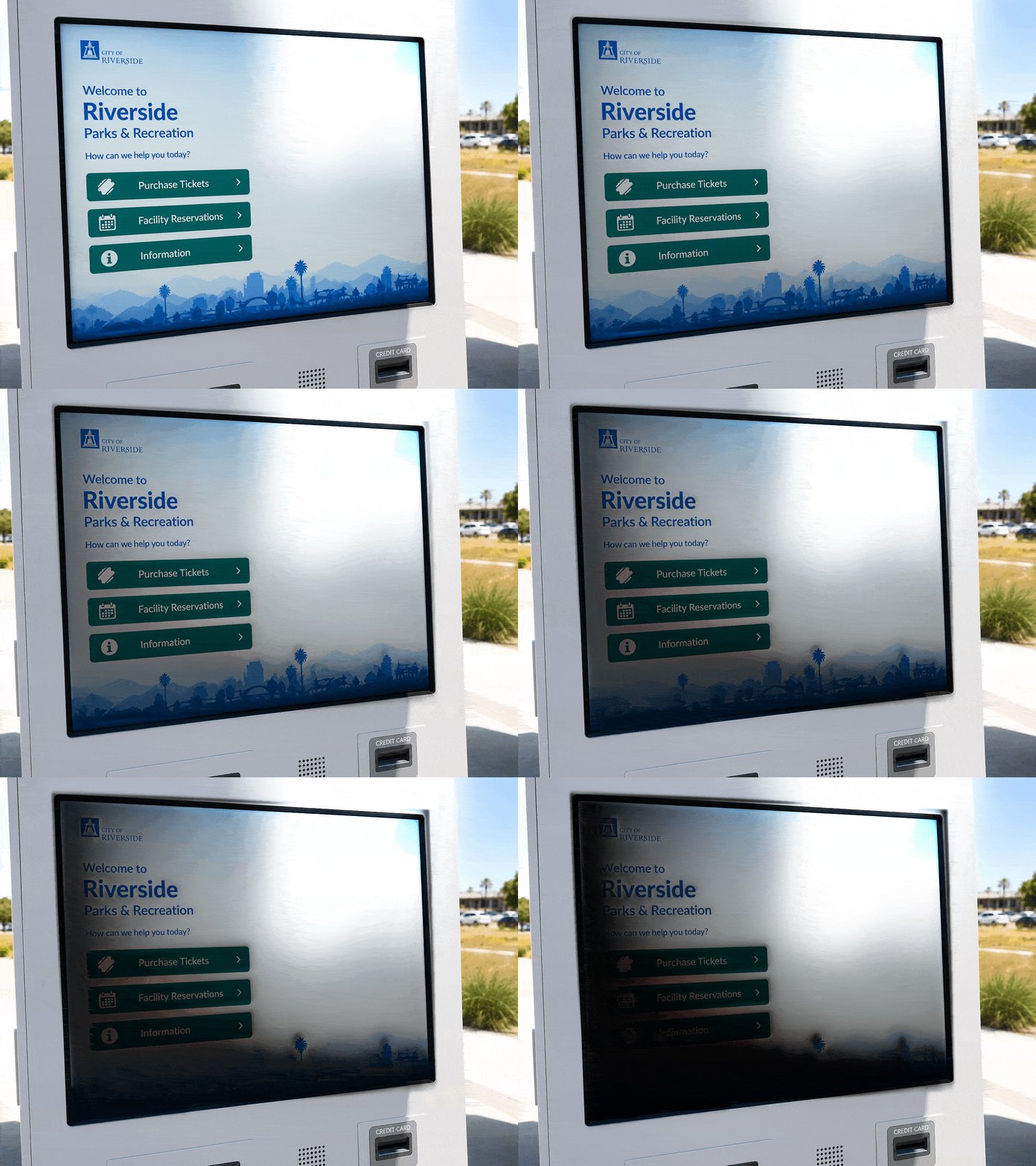
Direct sunlight on an LCD display can lead to screen blackout
Solar clearing is generally reversible once the cell cools, but repeated excursions accelerate ageing of the polarisers and alignment layers and shorten panel life. A phone that gets too hot can simply shut down; an outdoor display can't - it must stay visible and legible whatever the conditions. Keeping the LC cell below its clearing point is therefore the single most important durability requirement for outdoor LCDs.
For the most thermally demanding installations, some manufacturers produce LCD panels with liquid crystal mixtures formulated for a higher clearing point - typically 90 °C or above, versus 70-80 °C for standard panels. These don't remove the need for cooling, but they raise the temperature at which black-out occurs, giving the system a useful margin against transient solar spikes or partial cooling failures. Knowing whether a project warrants one is part of specifying the right display for the environment.
Cooling: the primary mitigation
Solar clearing is a heat problem, so the fix is cooling. Most outdoor displays use a mix of passive and active cooling, sized for the worst sun the installation will ever see.
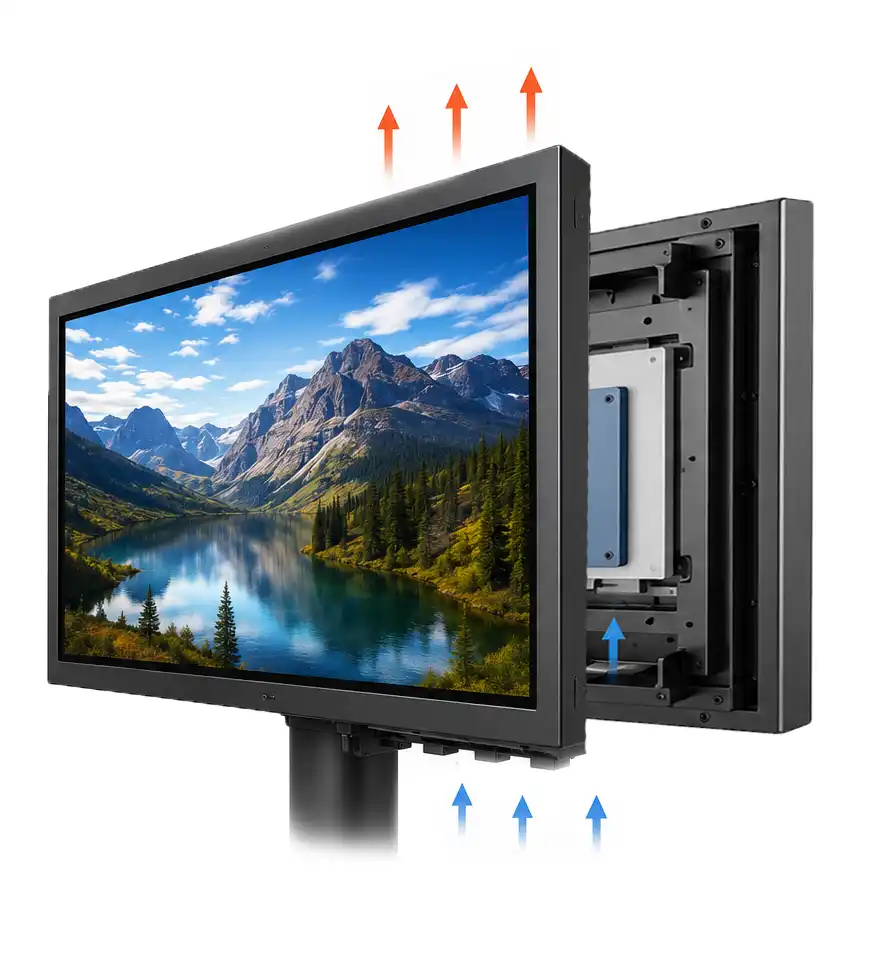
Passive measures move heat away from the LC cell without consuming power - rear-mounted heat sinks bonded to the backlight chassis, internal heat-spreading plates, low-emissivity rear coatings, and enclosure design that promotes natural airflow. On their own, these are rarely enough for a high-brightness display in direct sun, but they set the thermal baseline the active system has to work from.
Active cooling carries the rest of the load, typically through a sealed two-loop system: an inner loop carries heat from the LCD to a heat exchanger, and an outer loop blows ambient air across the exchanger to dump it outside. The panel stays sealed against dust and moisture, but the heat still moves out efficiently.
Brightness management
Backlight power is itself a major heat source. Running a 2,500 nit backlight at full output around the clock is both unnecessary - ambient light at night is a tiny fraction of midday levels - and thermally costly. An ambient light sensor lets the display run at full brightness only when sunlight demands it, dropping to a small fraction of peak output at night and in overcast conditions. The result is cooler LEDs, a cooler panel, and a longer service life - internal heat generation can drop by more than half over a 24-hour cycle, extending LED life and easing the cooling system's duty cycle.
UV damage: how sunlight degrades outdoor LCDs
Where solar clearing is a heat effect and reversible, UV damage is chemical and permanent. The polarisers, colour filters, and adhesives inside an LCD are all organic materials, and prolonged UV exposure breaks them down. The screen yellows, colours fade, contrast drops, and the polarisers develop a hazy brown cast as they bleach.
The standard fix is a UV filter built into the cover-glass bonding layer, blocking wavelengths below about 380 nm while letting visible light through. Without one, polarisers in direct sun can degrade up to ten times faster than they would indoors - and once bleached, they can't be brought back.
Ceramic ink printing
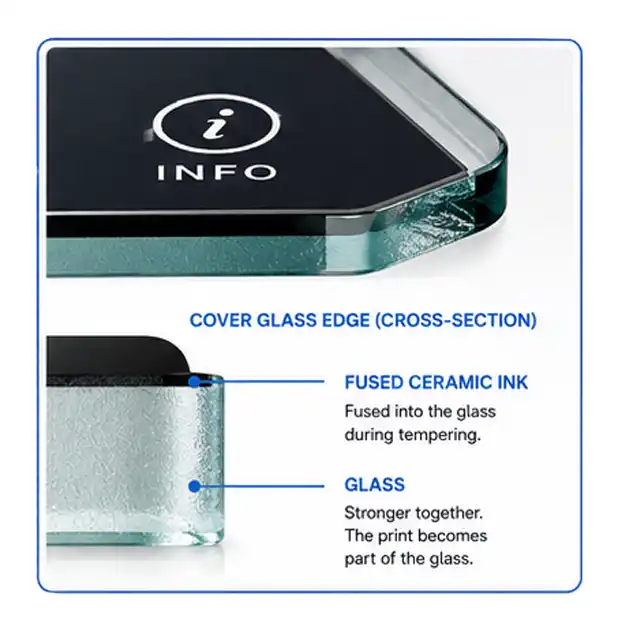
Logos, bezels, and icons printed on the cover glass face the same UV and heat as the optical stack behind them. Conventional inks crack, fade, and peel - a visible quality problem long before the display itself fails.
Ceramic inks fuse directly into the glass during tempering. Because the print becomes part of the glass rather than a film on top of it, it shrugs off UV, temperature swings, cleaning chemicals, and scratches - which matters wherever the screen is within reach of the public.
Optical bonding: better contrast and sealed against moisture
Optical bonding fills the gap between the cover glass and the LCD with a clear resin or silicone gel matched to both surfaces. Without it, every time light crosses from glass to air or air to glass, around 4% of it reflects back - light that hurts contrast and ends up absorbed elsewhere in the stack as heat. Optical bonding gel fills the gap, cutting both reflections and heat load.
Bonding also seals the optical stack against moisture and stops condensation forming on the inside of the cover glass. Unbonded displays in humid environments often develop internal fogging or polariser delamination at the edges; bonded ones don't.
Find out more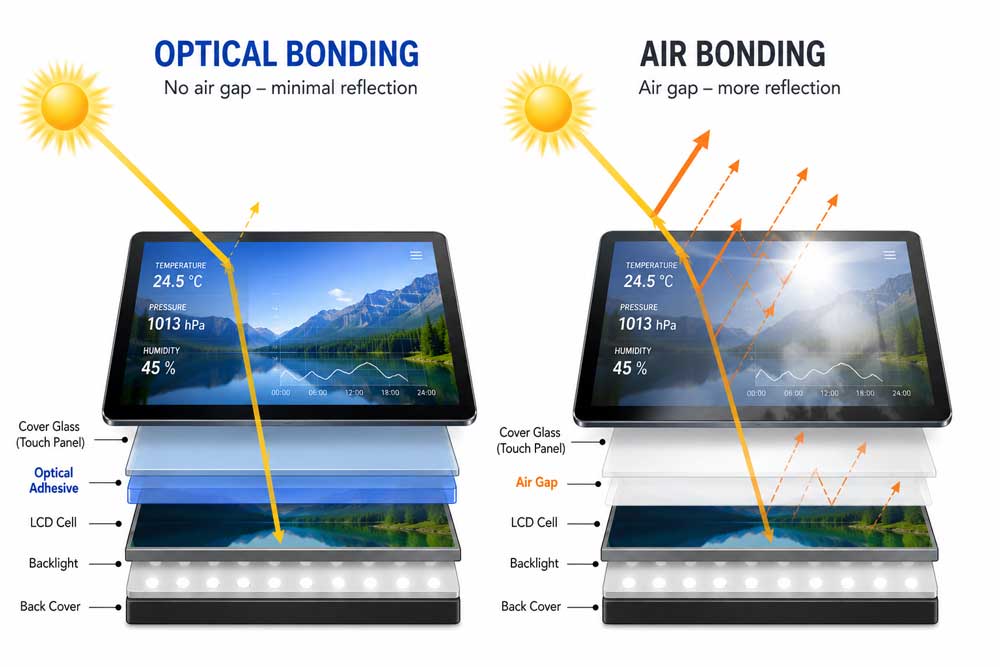
Specifying for a long service life
No two outdoor installations face the same conditions, and no single fix covers them all. Active cooling, UV filtering, optical bonding, ceramic-ink cover glass, ambient light sensing, and high-clearing-point panels each address a distinct failure mode - and the right combination depends entirely on where the display is going and what it has to do.
That's why we design every outdoor display around the application, not the other way round. Tell us where the display is going, how it'll be used, and what it needs to survive, and we'll work out the right specification to keep it performing for years.
If you have an outdoor display project in mind, get in touch - we'd love to help!
Get in touch today: